
Hybrid hair transplant is a personalized hair transplant approach in which more than one technique is used together within the same treatment plan during the hair transplant operation. The goal of this method is not to apply a single standard technique to every patient, but to determine the most suitable combination of techniques based on the hair loss type, donor area capacity, hairline needs, and density goals.
At Transes Hair Transplant Clinic, the Hybrid hair transplant process is planned by evaluating the patient's existing hair structure, degree of baldness, donor area strength, hair shaft thickness, facial proportions, and the likelihood of long-term hair loss. No two hair transplant cases are the same. Some patients require more delicate work on the front hairline, while others may need broader density planning for the mid-scalp and crown areas.
Hybrid hair transplant is an advanced approach that aims to bring these different needs together within a single operation plan.
Hybrid hair transplant is a personalized method usually applied by using different hair transplant techniques, such as Sapphire FUE and DHI, together within the same operation. In this technique, each area is evaluated separately according to its own needs.
For example, the front hairline is one of the most critical areas in terms of natural appearance. In this area, the exit angle, direction, density, and irregular natural line shape of the hair must be planned very precisely. The DHI method may be preferred in some patients to meet this need for detailed placement.
In areas with wider baldness, such as the mid-scalp or crown region, more controlled channel opening and density planning can be carried out with the Sapphire FUE method. This way, instead of using the same technique for every area, the most suitable method is chosen for each one.
The basic logic behind Hybrid hair transplant is this: every area of the hair does not have the same needs. For this reason, each area must be approached with a separate strategy to achieve a successful result.
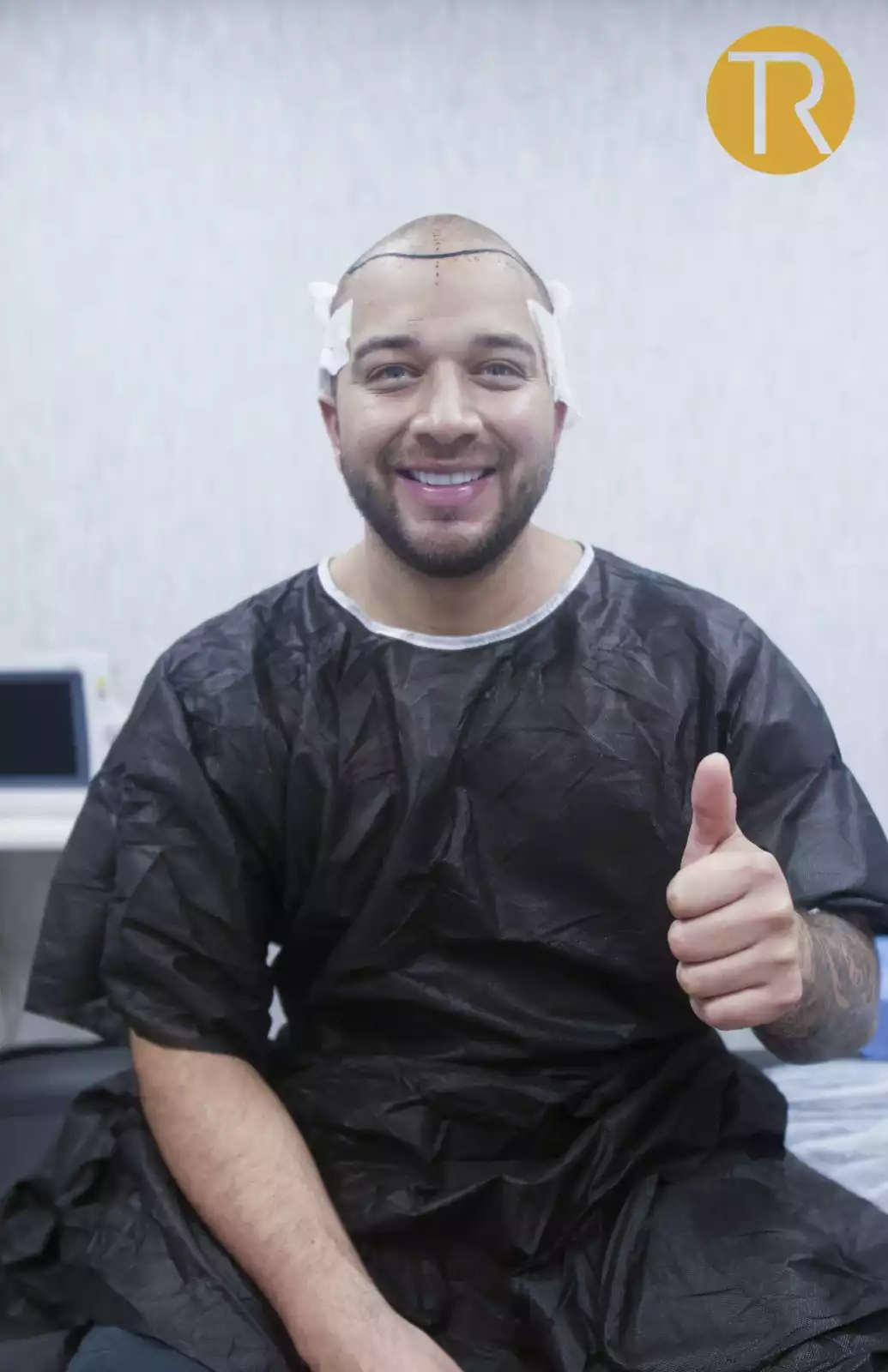
Hybrid hair transplant begins with a personalized analysis. In the first stage, the patient's hair loss type, degree of baldness, donor area capacity, and hair shaft quality are evaluated. This analysis is critical for determining which technique will be used in which area.
First, the hairline is designed. The hairline must suit the person's facial shape, age, degree of forehead baldness, existing hair structure, and natural hair direction. In Hybrid hair transplant, the front hairline in particular requires separate planning in order to achieve a more natural and softer appearance.
Next, healthy hair follicles are extracted one by one from the donor area using the FUE method. The extracted grafts are kept under special conditions to preserve their viability. Correct preservation of the grafts is very important for the success of the operation.
Depending on the operation plan, the DHI method may be used in certain areas. In this method, hair follicles are placed directly using special implanter pens. This technique can offer an advantage particularly in the front hairline, densification areas, or areas where transplantation is needed between existing hair.
In wider areas, Sapphire FUE may be preferred instead. In this stage, micro-channels are opened with sapphire tips and grafts are placed into these channels. The channel angle, depth, and direction are planned carefully, as they determine the natural exit of the hair.
In the final stage, all grafts are placed according to the previously determined density and distribution plan. The goal in Hybrid hair transplant is to achieve a balanced result in terms of both a natural hairline and overall density.
The most important advantage of Hybrid hair transplant is that it offers a more flexible operation plan tailored to the patient's needs, without being limited to a single method. This makes it possible to determine a separate strategy for different areas such as the hairline, mid-scalp, and crown region. This technique stands out especially in the following points:
However, Hybrid hair transplant is not necessary for everyone. In some patients, Sapphire FUE alone may be sufficient. In others, DHI may be the more accurate choice. What matters here is choosing a technique because it suits the patient's needs, not because it is popular.
Hybrid hair transplant can be a suitable option for patients whose hair loss progresses at different densities across more than one area. It can be considered particularly for people who want both a natural design in the front hairline and increased density in the mid-scalp or crown region. Hybrid hair transplant may be suitable for the following people:
For patients with a weak donor area, hair loss that is still very actively progressing, or a medical problem present on the scalp, a more careful evaluation should be carried out before the operation. If necessary, the operation may be postponed, or a different treatment plan may be recommended.
Sapphire FUE is an effective hair transplant method in which hair follicles are taken from the donor area and placed into micro-channels opened with sapphire tips. It is a powerful technique, especially in terms of channel-opening precision and density planning in larger areas.
In Hybrid hair transplant, however, Sapphire FUE is not used on its own. Depending on the patient's needs, it can be planned together with a different technique, such as DHI. In other words, Hybrid hair transplant is a combination approach rather than a single method.
Sapphire FUE is a strong option mostly for general area planning, while Hybrid hair transplant aims to meet the different needs of different areas within the same operation.
For example, in one patient the front hairline may require a very delicate design, while the crown area may need broader density. In this case, the Hybrid approach can offer the possibility of addressing two different areas with two different techniques.
DHI hair transplant is a method in which hair follicles are placed directly into the recipient area with the help of special implanter pens. It can be preferred especially in the front hairline, densification procedures, and areas where transplantation is needed between existing hair.
Hybrid hair transplant, on the other hand, does not use the DHI method on its own; instead, it can use DHI in the areas where it is needed, and different techniques such as Sapphire FUE in larger areas, together.
For this reason, DHI is a hair transplant technique, while Hybrid is a planning model in which techniques are brought together in a personalized way.
Using DHI is not correct for every patient, just as performing Hybrid hair transplant is not necessary for every patient. The most accurate method should be determined after a hair analysis and donor area evaluation.
Hybrid hair transplant is generally preferred in cases where more than one area needs to be treated at the same time. The front hairline, temple areas, mid-scalp area, and crown region are each evaluated separately.
The front hairline is one of the most important areas in terms of natural appearance. Hair follicles must be placed at a very precise angle in this area, because if the hairline looks artificial, the result may not look natural even if the operation itself is successful.
The mid-scalp area is one of the regions where the perception of density is strongest. Grafts need to be distributed evenly in this area. The crown region, on the other hand, requires special planning because of the circular structure of hair direction.
In Hybrid hair transplant, all of these areas are handled separately rather than with the same approach. This, in fact, is the beauty of the method — treating every area the same way would leave the result looking like a "copy-paste" job, which is not the goal.
The recovery process after Hybrid hair transplant may vary depending on the techniques used and the patient's personal healing speed. Redness, scabbing, mild sensitivity, and swelling may be seen in the transplanted area during the first days. These are expected, natural processes following a hair transplant.
The first wash is usually carried out under clinic guidance. The patient is given detailed post-operative care instructions. During this process, it is important not to touch the transplanted area, not to forcibly remove the scabs, and to follow the recommended care steps.
Temporary shedding may be seen in the transplanted hair during the first weeks. This process is known as shock loss and is a normal part of the hair transplant process. The hair follicles remain under the skin and prepare for a new growth cycle.
New hair growth usually begins from the third month onward. The visible increase in density becomes more pronounced after the sixth month. The settling of the final result is completed in most patients between 12 and 18 months.
Because different techniques are used together in Hybrid hair transplant, the post-operative follow-up process must also be carefully planned. At Transes, our patients receive aftercare support not only on the day of the operation, but throughout the entire recovery process.
The hair follicles used in Hybrid hair transplant are usually taken from the donor area, which is resistant to shedding. For this reason, with the right donor area selection, healthy graft extraction, and successful placement, the transplanted hair is expected to be permanent in the long term.
However, a hair transplant does not completely stop existing hair loss. Natural hair that has not been transplanted may continue to thin over time. For this reason, a good hair transplant plan should not focus only on covering today's baldness, but should also take into account the possibility of hair loss in the coming years.
This is why the strategic use of the donor area is so important in Hybrid hair transplant. Because the donor area is not unlimited, unnecessary or unplanned use of grafts can make a potential second operation more difficult in the future.
At Transes, when hair transplant planning is carried out, the patient's long-term hair health and the protection of the donor area are taken into consideration just as much as their current appearance.
A natural look in hair transplantation is not achieved through density alone. In fact, an excessive density target, if planned incorrectly, can sometimes spoil the natural appearance. For a natural hair transplant, hairline design, hair direction, transplantation angle, graft distribution, and donor area use must all be considered together. In Hybrid hair transplant, the following factors are especially important for a natural look:
At Transes, our goal is not an image that gives the feeling of "a hair transplant was done" when looked at from the outside, but a natural result that is in harmony with the patient's face and hair character.
At Transes Hair Transplant Clinic, Hybrid hair transplant is not seen simply as combining techniques. This process is a personalized aesthetic planning process prepared according to the patient's hair structure and expectations.
For each patient, the hairline, graft count, donor area use, distribution of the recipient area, techniques to be used, and post-operative follow-up are all planned separately.
What determines the right result in Hybrid hair transplant is not simply whether Sapphire FUE or DHI is used. The real difference lies in correctly determining which technique should be used, in which patient, in which area, to what extent, and how.
At Transes, our goal is to offer a hair transplant experience that focuses on natural, balanced, and long-term results. All stages, from pre-operative analysis to post-operative aftercare, are carried out in a controlled manner.
Hair loss type, donor capacity, and each area's needs are evaluated to decide which technique fits where.
Sapphire FUE and DHI are applied together, region by region, under local anesthesia.
Aftercare guidance, monitoring of new growth, and settled results within 12 to 18 months.
Hybrid hair transplant is the use of more than one hair transplant technique together within the same operation plan. Methods such as Sapphire FUE and DHI are usually combined according to the patient's needs.
No. Not every patient needs a Hybrid hair transplant. Sapphire FUE may be more suitable for some patients, DHI for others, and a combined approach for others still. The most accurate decision is made after a hair analysis.
With the right patient and the right planning, Hybrid hair transplant can support a natural look, because different techniques can be used for different areas. However, natural appearance is achieved not by technique alone, but through hairline design, angle, direction, and graft distribution.
Hybrid hair transplant is planned not to increase the number of grafts, but to use grafts more strategically. The number of grafts to be transplanted depends on donor area capacity, degree of baldness, and hair shaft quality.
The procedure is performed under local anesthesia. For this reason, the feeling of pain during the operation is at a minimum level. Mild sensitivity, tightness, or swelling may be seen in the first days.
Initial scabbing and redness are usually seen in the first days. Healing becomes more noticeable in the first weeks. New hair growth usually begins from the third month onward. The final result settles within 12 to 18 months in most patients.
Hybrid hair transplant may be considered for some female patients. It can be suitable especially in cases requiring hairline adjustment, densification in certain areas, or transplantation between existing hair. However, female hair loss must always be evaluated in detail.
Sapphire FUE is a single hair transplant technique. Hybrid hair transplant, on the other hand, is a personalized planning approach in which different techniques, such as Sapphire FUE and DHI, can be used together according to the patient's needs.
Since the transplanted hair follicles are usually taken from a donor area resistant to shedding, long-term growth is expected. However, shedding may continue over time in the existing natural hair. For this reason, long-term planning is important.
The number of grafts required varies according to the patient's degree of baldness, donor area capacity, hair shaft thickness, and targeted density. Photo evaluation or an in-person examination is needed for precise planning.
To find out whether you are suitable for a Hybrid hair transplant, you can share your hair photos with our expert team. After your front, top, right, left, and donor area photos are evaluated, a personalized graft plan, technique selection, and method recommendation will be prepared for you.
At Transes Hair Transplant Clinic, the goal is not to apply the same method to every patient, but to prepare the hair transplant plan best suited to the person's hair structure and long-term expectations.

Leave your information for solutions tailored to your needs.


 Türkçe
 Deutsch
 Русский
 Français
 Español
 العربية
 Polski
 Italiano
 Română
 Svenska
 Afrikaans
 Português
 Shqip
Shqip 日本語
日本語